
Areas of Focus
Paroxysmal Supraventricular Tachycardia (PSVT)
PSVT is caused by an abnormality in the electrical system of the heart. People with this abnormal heart rhythm have unexpected episodes of rapid heart rate that start and stop suddenly.
A normal resting heart rate is between 60 and 100 beats per minute. During an episode of PSVT, a patients’ heart rate increases, typically between 100-250 beats per minute.
While experiencing an episode of PSVT, symptoms may include palpitations, sweating, chest pressure or pain, shortness of breath, sudden onset of fatigue, fainting, and anxiety.
Frequency and Severity
PSVT can begin at any time in a patient’s lifetime and may occur in otherwise healthy patients. The frequency and severity of episodes vary from patient to patient and can even vary within an individual patient. Our market research shows that patients living with PSVT experience an average of 12 to 15 episodes per year despite up to two-thirds of them taking daily prescription medications to prevent them. Episodes may last anywhere from minutes to hours and can be debilitating for patients, leaving them unable to focus on family or work. Market research also shows that approximately 60% of patients with PSVT experience multiple 10+ minute moderate to severe episodes per year, and approximately 40% experience an average duration of at least 30 minutes per episode.
While PSVT is not typically life threatening, the uncertainty of when an episode will occur and how long it will last can have a significant impact on patient quality of life. Researchers have noted that up to 27% of patients living with PSVT stopped driving for fear of temporary loss of consciousness. Furthermore, patients often feel anxious in anticipation of future PSVT episodes and frustrated by their lack of a sense of control.
Prevalence and Incidence
PSVT affects approximately two million Americans and results in as many as 300,000 new diagnoses and between 650,000 and 1,000,000 healthcare claims per year in the US, including emergency department visits, hospital admissions, and ablations. These estimates are based on IQVIA Pharmetrics Plus 2019 Commercial claims for patients <65yo and Medicare LDS 5% for patients >65yo (ICD: I47.1).
A 2021 retrospective, observational, longitudinal analysis published in the Journal of Cardiovascular Electrophysiology utilized claims data from both Medicare and private insurers to estimate the treated prevalence and incidence of PSVT in the U.S. over a 9-year period (2008-2016). This study found that the U.S. treated prevalence for PSVT was 1.3 to 2.1M, with approximately 190,000 to 310,000 new cases each year. Women are affected at a higher rate, comprising two out of every three patients.
Compared to past analyses, the updated PSVT prevalence and incidence data show more than two-fold increases. Earlier published sources documenting the demographics, clinical characteristics, and epidemiology of PSVT rely on a single medical encounter confirmed by an ECG. Thus, these studies estimate the prevalence and incidence of patients with PSVT presenting to the healthcare system during an active SVT episode. They likely significantly underestimate PSVT prevalence due to the episodic nature of the disease, the variability in the duration of SVT episodes, and the fact that the majority of SVT episodes are experienced outside the healthcare setting.
This retrospective, observational, longitudinal analysis—which accounted for misdiagnoses and overlap with symptoms of AFib/AFL—generated a more definitive, updated treated prevalence estimate of PSVT within the U.S. population. Since the minority of adjudicated PSVT was determined to originate from the PSVT code in prior studies, there are likely additional patients with PSVT receiving other diagnosis codes that are not included in the 1.3-2.1M treated prevalence estimate.
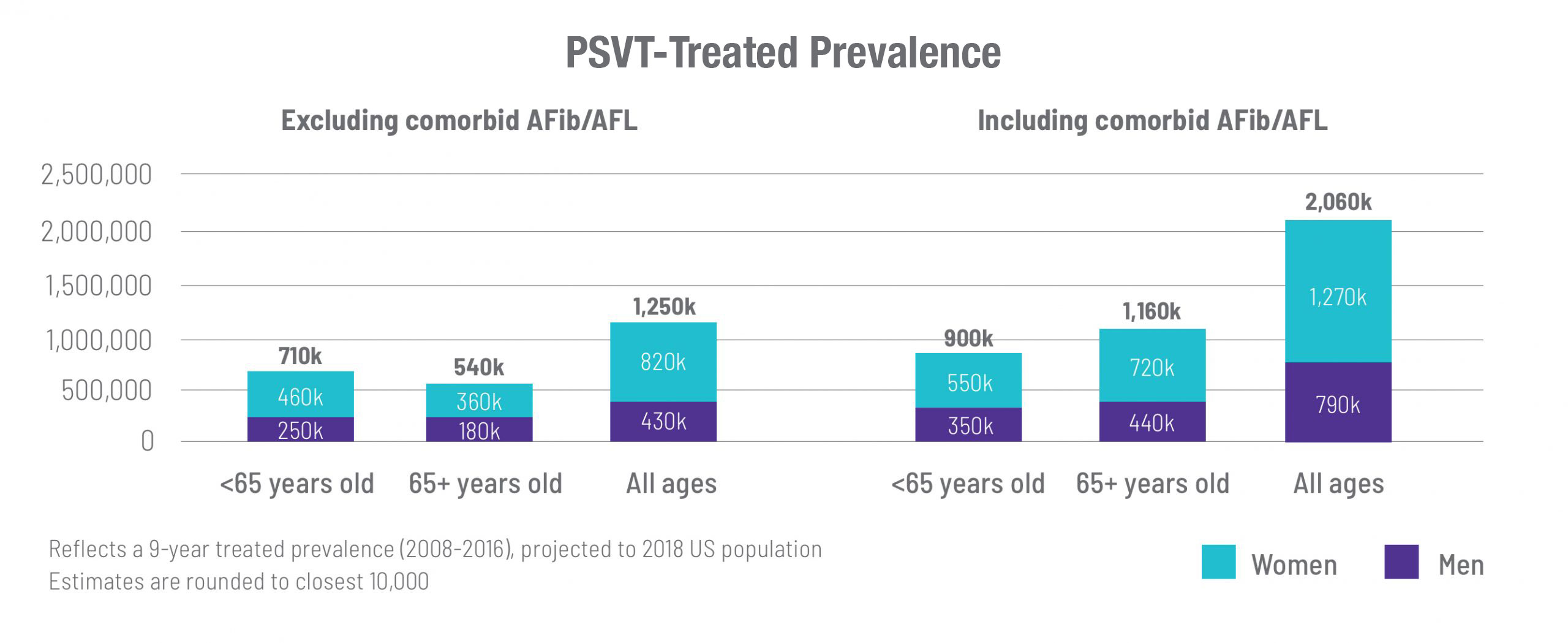
Those living with PSVT may have other comorbid arrhythmias, such as AFib or AFL. Excluding patients with comorbid AF/AFL leads to a conservative estimate of PSVT treated prevalence in the U.S. (~1.3M), while including those with comorbid AF/AFL suggests a U.S. treated prevalence of approximately 2.1M.
Healthcare Economics
The current standard of care for PSVT consumes significant healthcare resources. Research published in the American Journal of Cardiology in 2020 shows that costs for patients rose significantly in the pre-diagnosis year due to the difficulty of obtaining an accurate diagnosis. In the year following diagnosis, costs triple for those less than 65 years of age and double for those over 65 years of age, compared to matched controls. Total healthcare expenditures in the year following PSVT diagnosis ranged from $20,000-$30,000 per patient, significantly higher than the expenditures observed for patients without PSVT (~$6,500 per patient). Significant increases for both age groups were noted for emergency department visits. For those less than 65, the average cost of hospitalizations doubled as their inpatient rates quadrupled. Of note, catheter ablations following diagnosis represent only 23% of this increased spend, meaning the majority of costs are unrelated to ablations.
Based on current data, we estimate approximately 100,000 catheter ablations, 140,000 to 525,000 Emergency Department visits and 40,000 to 120,000 inpatient hospitalizations for PSVT occur each year, driving the majority of the approximately $5 billion spent annually in the U.S. on the management of PSVT.
Looking to the broader landscape of economic burden on our health system from cardiac treatments, a 2021 study released in the American Heart Journal found patients <65 living with PSVT can cost the health care system a comparably similar amount to patients with AFib—the most common arrhythmia diagnosed in U.S. clinical practices. This study followed patients for up to six years post-diagnosis. Similar to the American Journal of Cardiology study, this data showed that costs never return to baseline, which indicates a need for more treatment options in long-term PSVT management.
How costly is PSVT to our healthcare system?
PSVT costs rise significantly from the year before to after diagnosis in both younger (<65 years) and older (≥65 years) patients
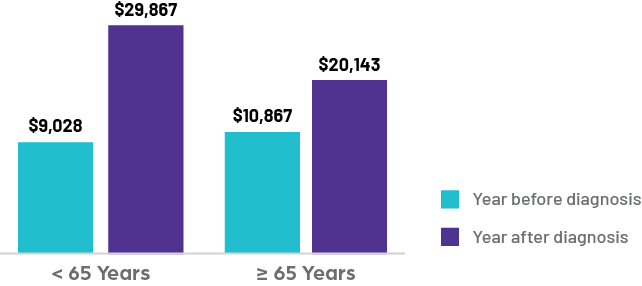
Cost Increases Include:

<65 years: 4x increase
≥65 years: 2x increase

<65 years: 2.5x increase
≥65 years: 33% increase
<65 years: 13% of patients
≥65 years: 3% of patients
Gender Disparity
Symptoms experienced by patients with PSVT are commonly misdiagnosed as anxiety or panic attacks, especially in women. Compared to men, it can take women more outpatient and emergency department visits to be correctly diagnosed. Following diagnosis, women are more likely to be treated with medical therapy to manage symptoms, while men are more often referred for an ablation.
Let’s Work Together
We collaborate with leading researchers, academic institutions, professional medical societies, and patient support organizations who are like-minded in the pursuit of PSVT knowledge and education. If you are interested in collaborating with us, please email us at grants@milestonepharma.com.
- Brugada, J., European Heart Journal. 2020;41(5):655-720.
- Chew, D. S., Am Heart J. 2021;233:132-140.
- Colucci, R. A., Am Fam Physician. 2010;82(8):942-952.
- 2019 market research with patients conducted by BluePrint Research Group (n=247)
- Page, R., J Am Heart Assoc. 2016;133(14):e506-e574.
- Rehorn, M., J Cardiovasc Electrophysiol.. 2021;32(8):2199-2206.
- Sacks, N. C., Amer J of Card. 2020;125(2):214-221.
- IQVIA Pharmetrics 2019 (ICD:147.1)
- Healthcare Utilization Project (HCUP) 2019
- Stambler, B., Lancet 2023; 4: 118-128.
- Wood, K., Eur J Cardiovasc Nurse 2007; 6(4):293-302


.png)